How to Help a Child Who Hates Getting Water on Their Face
A child can love the idea of swimming and still hate one particular part of it: getting water on their face.
For some children, even a small splash around the eyes or nose can trigger an immediate reaction. They may wipe their face repeatedly, lift their head as soon as it touches the water or become upset when an instructor asks them to blow bubbles.
This is very common among beginners.
The good news is that water confidence does not have to be built through dramatic moments. Small, repeated and positive experiences are often much more useful than trying to rush a child into putting their whole face underwater.
Here are some practical ways to help.
Why do some children hate water on their face?
There can be lots of reasons.
For a beginner, the sensation itself may simply feel unfamiliar.
Water around the eyes, nose and ears can be surprising when a child has not yet learnt what to expect.
Some children dislike losing their usual sense of control. Others may have had an unpleasant experience in the past, such as swallowing water, slipping in the pool or being unexpectedly splashed.
Sometimes there is no obvious reason at all.
The important thing is not to assume your child is being difficult.
If they are genuinely uncomfortable, building confidence gradually is usually more helpful than trying to convince them that there is nothing to worry about.
Start with splashing before submerging
A child does not need to begin by putting their whole face underwater.
Start smaller.
During supervised pool time, let them become comfortable with water reaching different parts of their face.
You might begin with:
- Wet hands touching the cheeks
- A little water on the chin
- Gentle splashes around the shoulders
- Water running over the back of the head
- Small splashes near the mouth
- Gradually getting closer to the nose and eyes
Let your child know what is going to happen.
Predictability can make a big difference.
A gentle splash they are expecting often feels very different from a splash that suddenly catches them by surprise.
Practise during bath time
The swimming pool is not the only place to build confidence.
Bath time can provide a familiar environment where children can explore water around their face without the noise and activity of a public pool.
Keep it playful.
Your child could:
- Blow gently across the surface of the water
- Pour water between cups
- Make bubbles
- Touch wet hands to their cheeks
- Practise closing their eyes before a small amount of water reaches their face
Do not turn every bath into a swimming lesson.
The aim is simply to make water around the face feel increasingly ordinary.
Teach blowing bubbles
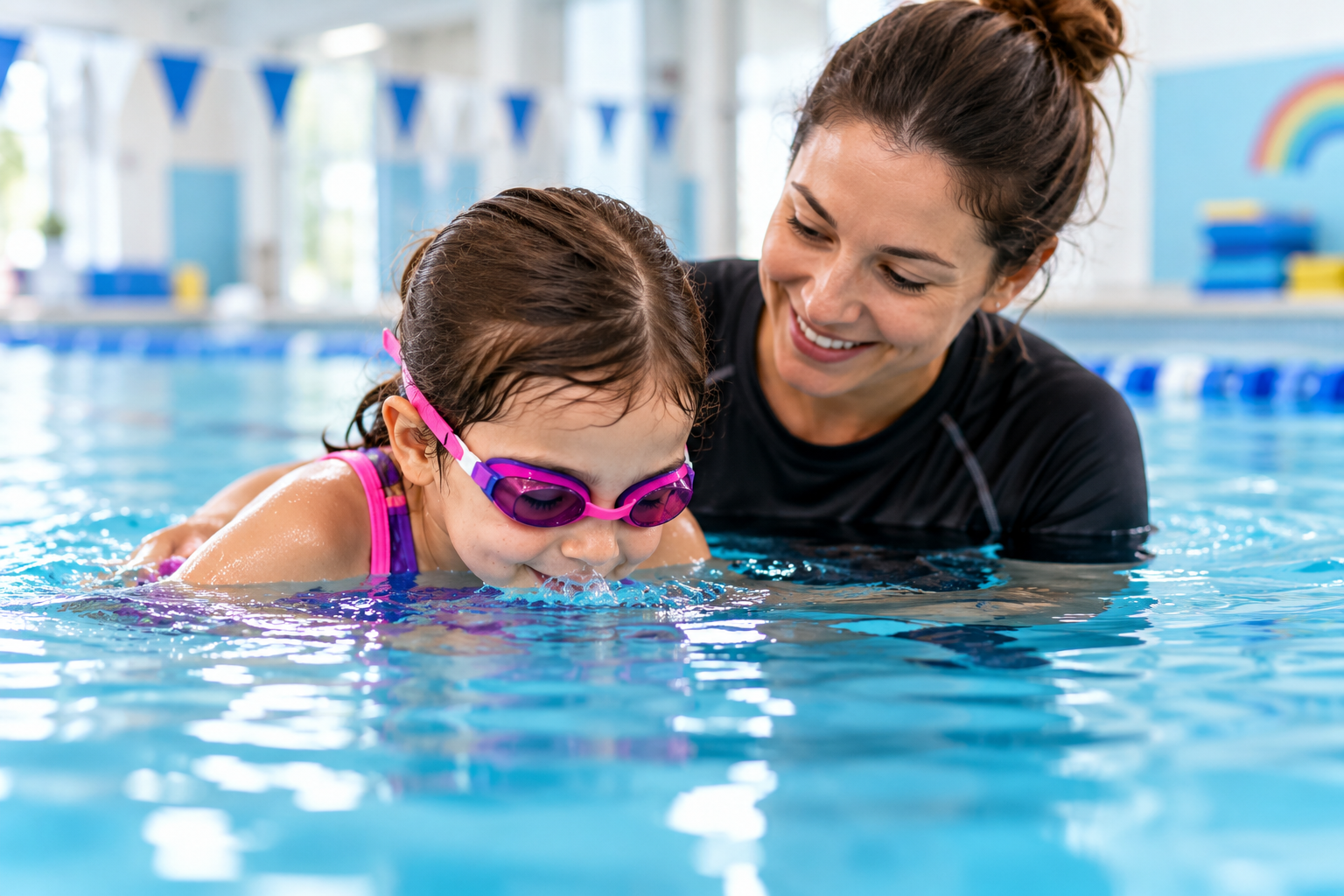
Blowing bubbles is one of the most useful early swimming skills.
It helps children learn that when their mouth is in the water, they can breathe out rather than trying to breathe in.
Start with the mouth only.
Ask your child to put their lips close to the surface and blow.
Once that feels comfortable, they can gradually place their lips into the water.
Later they may be happy to put their mouth and nose in, followed eventually by more of the face.
You can make it playful by asking them to make tiny bubbles, giant bubbles or the longest bubbles they can manage.
The goal is familiarity, not perfection.
Avoid forced dunking
If a child is already worried about water on their face, unexpectedly putting their head underwater can make that fear stronger.
Avoid pushing, pulling or forcing their head beneath the surface.
Even if they come up physically fine, they may remember the feeling of having no control over what happened.
Instead, work towards submersion gradually.
A child who chooses to put their own face into the water has had a very different experience from one who has been forced underneath.
Giving them some control can be an important part of building confidence.
Let your child choose the next small step
You do not always need to decide what the next milestone should be.
Try offering two manageable choices.
For example:
"Would you like to put your chin in or blow bubbles?"
"Would you like one little splash or three?"
"Would you like to try with goggles or without?"
Small choices can help a child feel involved rather than feeling that swimming is something being done to them.
The options should both be reasonable and comfortable for their current ability.
Can swimming goggles help?
For some children, yes.
One reason children dislike putting their face into the water is that they do not like water around their eyes or cannot see clearly underwater.
Goggles can remove some of that uncertainty.
Being able to see the pool floor, their instructor or underwater toys can make putting the face in feel more interesting and predictable.
However, goggles are not a guaranteed solution.
Some children initially dislike the sensation of goggles around their eyes just as much as they dislike the water.
Let them try goggles away from the pool first so they can get used to the fit.
Should children practise without goggles too?
It can be useful for children to gradually become comfortable with some water around their face even when goggles are not being worn.
That does not mean taking away goggles they enjoy using.
Goggles can be a very useful piece of swimming equipment.
But if a child accidentally loses or removes them during a lesson, ideally the experience should not make them immediately panic.
Follow the approach of your child's swimming instructor. Teachers often include a mixture of activities designed to develop general water confidence as well as swimming skills.
Make face dipping a game
Games can make unfamiliar skills feel less serious.
Depending on your child's confidence, you might try activities such as:
- Blowing bubbles to make the water move
- Counting how many bubbles they can make
- Looking for a brightly coloured object underwater
- Dipping the chin in and out
- Putting the mouth in to make silly sounds
- Copying an adult or sibling
- Taking turns
Keep the games appropriate for their current ability and always supervise closely around water.
If your child says they have had enough, it is usually better to finish positively than to keep pushing until they become upset.
Celebrate small progress
Adults sometimes focus on the final goal: putting the whole face underwater.
For a nervous child, there may be many important steps before that happens.
Progress might mean:
- Entering the pool without worrying
- Letting water touch their cheeks
- Allowing a splash near their eyes
- Putting their chin in
- Blowing bubbles with their mouth
- Putting their nose into the water
- Briefly dipping their whole face
Those are all meaningful steps.
Recognising small improvements can help children see that they are getting better even before they are confidently submerging.
Try not to compare them with other children
Swimming lessons make comparison very tempting.
You may see another child of the same age happily diving underwater while yours is still reluctant to get their nose wet.
That does not tell you very much about how your child will eventually progress.
Children arrive at swimming lessons with different personalities, experiences and confidence levels.
One child may be comfortable underwater but struggle with kicking.
Another may initially dislike water on their face but later become a very confident swimmer.
Focus on changes in your own child's confidence rather than how they compare with the child in the next lane.
Talk positively about swimming
Children pick up a lot from the way adults describe experiences.
Try to keep swimming language calm and matter-of-fact.
Rather than repeatedly asking:
"Are you scared?"
you might ask:
"What did you enjoy today?"
or:
"What did you practise?"
That shifts attention towards what happened rather than reinforcing the idea that swimming is something frightening.
At the same time, avoid dismissing genuine worries.
You can acknowledge that something feels difficult while still showing confidence that they can work on it gradually.
Speak to the swimming instructor
If your child regularly becomes upset when asked to put their face into the water, let the instructor know.
They may already be aware, but a quick conversation can help you understand how your child behaves during the lesson when you are not directly beside them.
Ask what they are currently practising and whether there are simple activities you can reinforce during supervised family swimming.
Keeping your approach similar to the instructor's can prevent your child receiving conflicting instructions.
What if my child is fine in the bath but scared in the pool?
This is not unusual.
A swimming pool can feel completely different.
It is larger, noisier and busier. There may be other children splashing nearby, an unfamiliar instructor and much deeper water.
A child who happily puts their face into bath water may still need time to transfer that confidence to the pool.
Use the skills they already have as a starting point.
If they can blow bubbles in the bath, remind them that they already know how to do the same action before trying it at the pool.
What if they accidentally swallow water?
Beginners will occasionally get water in their mouth while learning.
If it happens, stay calm.
Help them move somewhere secure, allow them to cough if necessary and give them time to recover before deciding whether they want to continue.
A dramatic adult reaction can make a small incident feel much more frightening.
At the same time, never pressure a distressed child to immediately repeat the activity.
Give them a moment and follow the instructor's guidance.
Should I practise outside swimming lessons?
Supervised family swimming can be helpful because there is often less pressure to perform a particular skill.
You can spend a few minutes practising something familiar and then simply enjoy the pool together.
That balance matters.
If every family swim becomes another structured lesson, a reluctant child may begin to associate the pool entirely with being asked to do things they find difficult.
Sometimes playing, splashing and having fun in the water is valuable confidence-building too.
How long does it take to become comfortable?
There is no fixed timeline.
Some children change dramatically after only a few positive experiences.
Others need many weeks or months before they feel comfortable putting their face underwater.
Progress may also move backwards occasionally.
A child who confidently submerged last week may refuse this week because they are tired, distracted or had an unpleasant splash.
That does not necessarily mean all their progress has been lost.
Look at the longer trend rather than one lesson.
When should I slow things down?
Consider slowing down if your child is becoming increasingly distressed rather than gradually more confident.
Signs might include:
- Crying before every lesson
- Refusing to enter the pool
- Becoming more fearful each week
- Panicking when an activity involving the face is mentioned
- Regularly asking to stop swimming altogether
Speak to their instructor before assuming they simply need more pressure or more practice.
Sometimes changing the pace, activity or approach is much more effective than repeatedly attempting the same thing.
The bottom line
A child who hates water on their face does not need to overcome the fear in one big moment.
Water confidence can be built through lots of small, predictable and positive experiences.
Start with gentle splashing.
Practise blowing bubbles.
Let your child have some control over the next step.
Use goggles if they help.
Praise progress that may seem small to an adult but feels significant to your child.
Most importantly, avoid turning face submersion into a battle.
The goal is not simply to get your child's head underwater. It is to help them become comfortable enough around water that swimming gradually feels familiar, enjoyable and manageable.
With patience, regular lessons and supportive practice, many children become far more confident than parents initially expect.
Get the gear mentioned in this article
All JIMJOOS products are available on Amazon with Prime delivery.
Shop on Amazon